Weight management is one of the most commercially saturated topics in health, and one of the most poorly communicated. The gap between what the research shows and what gets marketed as a solution is wider here than almost anywhere else in the wellness space.
This article focuses on the biology of weight regulation in women, the evidence on what actually works, and the common approaches that the research consistently fails to support.

Why Weight Management Is Different for Women
Female physiology creates a genuinely distinct metabolic landscape compared to male physiology, and much of the popular advice on weight management has been developed primarily from research on men.
Hormonal cycling affects appetite, energy expenditure, food preferences, and fat storage throughout the menstrual cycle. Progesterone in the luteal phase increases basal metabolic rate slightly while simultaneously increasing appetite and cravings, which creates a physiological drive that caloric restriction models typically ignore.
Body composition differences mean that women naturally carry a higher proportion of body fat relative to total body mass than men, reflecting evolutionary priorities around reproductive capacity. This is not a defect to be corrected but a physiological baseline to be understood.
Estrogen plays a significant role in fat distribution. Premenopausal women tend to store fat preferentially in subcutaneous depots (hips, thighs), while the estrogen decline of menopause shifts fat distribution toward visceral (abdominal) accumulation, which carries higher metabolic and cardiovascular risk. This shift occurs independently of total weight change.
Thyroid function is more commonly disrupted in women, and hypothyroidism produces symptoms including weight gain and difficulty losing weight that are frequently misattributed to diet or willpower.
The Limitations of Calorie Restriction as a Primary Strategy
The energy balance model (calories in versus calories out) is not wrong, but it is incomplete in ways that matter practically.
Sustained caloric restriction triggers adaptive responses that work against weight loss. Metabolic rate decreases, not only because of reduced body mass but through active down-regulation of thermogenesis. Hunger hormones (ghrelin) increase and satiety hormones (leptin) decrease in patterns that persist long after the active restriction period ends. These adaptations are well-documented in the literature and are likely more pronounced in women, given leptin’s interaction with reproductive hormones.
The practical consequence is that severe caloric restriction produces initial weight loss followed by metabolic adaptation that makes further loss increasingly difficult and regain highly likely. Studies following participants of large weight loss interventions show that most regain the majority of lost weight within three to five years, not primarily because of behavioral failure but because of these physiological responses.
This does not mean caloric awareness is irrelevant; it means that approaches which rely exclusively on restriction without addressing other variables have poor long-term outcomes in the evidence base.
One specific pattern deserves direct attention here: weight cycling, the repeated loss and regain that follows this exact dynamic, sometimes called yo-yo dieting. For years the evidence on whether weight cycling itself carries independent health risk, beyond simply being overweight, was genuinely mixed. More recent meta-analyses have shifted this picture meaningfully. Pooled data from observational studies has found that body weight fluctuation is independently associated with increased cardiovascular disease risk and all-cause mortality, and animal and human studies both show that repeated cycles of loss and regain increase inflammatory activity in adipose tissue and impair pancreatic beta-cell function over time, separate from whatever the starting or ending weight happens to be. The practical implication is not that attempting weight loss is dangerous. It is that an approach predictably leading to repeated regain may carry a real physiological cost beyond simply not working, which is one more reason the evidence consistently favors slower, sustainable changes over aggressive restriction cycles.
Muscle Mass: The Most Underappreciated Variable

Lean muscle mass is the primary determinant of resting metabolic rate. More muscle means a higher baseline caloric expenditure, greater insulin sensitivity, and a body composition that manages weight more efficiently over time.
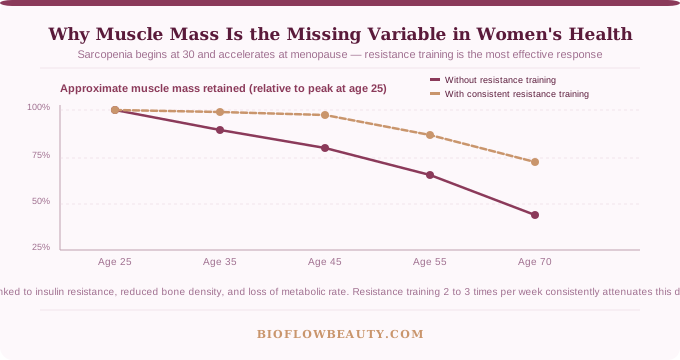
Women lose muscle mass at a rate of approximately 3 to 8 percent per decade after age 30, with acceleration after menopause. This progressive loss, known as sarcopenia, is one of the primary metabolic drivers of age-related weight gain even in the absence of dietary change.
Resistance training is the most effective intervention for preserving and building muscle mass, and its effects on body composition extend beyond what the scale reflects. A woman who adds muscle while losing fat may see minimal weight change while experiencing significant improvements in metabolic health, strength, and appearance.
The research on resistance training for women is clear and consistent: it is beneficial across all age groups, does not produce the bulk that many women fear (which requires substantially higher testosterone than female physiology produces), and has demonstrable effects on insulin sensitivity, bone density, and cardiovascular risk markers.
A second, less discussed variable belongs in the same conversation as muscle mass: non-exercise activity thermogenesis, or NEAT, the energy expended through everyday movement that is not formal exercise, walking, standing, fidgeting, household tasks, and general daily activity. Research on this specific component of energy expenditure has found that it varies by as much as 2,000 kcal per day between two people of similar size, driven largely by occupation and lifestyle rather than deliberate exercise. This matters practically because someone with a desk-based routine who adds a daily gym session can still have dramatically lower total daily movement than someone with an active job who never sets foot in a gym. Standing, taking walking breaks, and simply moving more throughout an ordinary day is a genuinely meaningful lever, not a consolation prize for people who dislike structured workouts.
💪 Collagen Peptides Collagen provides the specific amino acids (glycine, proline, hydroxyproline) that support connective tissue remodeling during resistance training. Growing evidence supports its role alongside adequate total protein for joint health and skin elasticity during body composition changes.
Check Collagen Peptides on Amazon →Hormonal Influences on Weight

Several hormonal conditions disproportionately affect women and have direct implications for weight management.
Insulin resistance affects how cells respond to insulin’s signal to take up glucose from the blood. When cells become resistant, the pancreas produces more insulin to compensate, and elevated insulin promotes fat storage. Insulin resistance is associated with polycystic ovary syndrome (PCOS), type 2 diabetes, and metabolic syndrome, all of which are more complex to manage with standard calorie restriction approaches.
PCOS affects an estimated 10 to 15 percent of women of reproductive age and is characterized by elevated androgens, irregular cycles, and insulin resistance. Women with PCOS frequently find weight loss more difficult than peers with equivalent dietary and exercise habits, and the evidence supports dietary approaches that prioritize blood glucose stability (adequate protein, fiber, and reduced refined carbohydrates) alongside resistance training.
Cortisol, the primary stress hormone, promotes abdominal fat storage when chronically elevated. The modern landscape of chronic psychological stress creates sustained cortisol elevation that directly affects body composition, particularly visceral fat accumulation. Stress management is therefore not a soft recommendation but a physiologically grounded component of weight management strategy.
Perimenopause and menopause bring hormonal shifts that affect fat distribution, muscle mass, and metabolic rate simultaneously. Women in this life stage frequently report that approaches that previously worked stop producing results. The evidence supports increased protein intake, resistance training, and in some cases discussion of hormone therapy with a physician as strategies for managing these changes.
What the Evidence Supports
No single dietary approach consistently outperforms others for long-term weight management in the research. What the literature does show:
Protein adequacy is consistently associated with better body composition outcomes, greater satiety, and preservation of muscle mass during weight loss. Targeting 1.2 to 1.6 grams per kilogram of body weight per day is supported by multiple trials.
Dietary fiber from whole foods supports satiety, feeds beneficial gut bacteria, and is associated with lower body weight in observational studies across populations.
Minimizing ultra-processed foods is associated with lower caloric intake, better appetite regulation, and improved metabolic markers. The mechanisms include effects on satiety signaling, gut microbiome composition, and eating rate.
Resistance training two to three times per week produces measurable improvements in body composition and metabolic rate that are sustained over time.
Adequate sleep is consistently associated with better weight management outcomes. Sleep deprivation increases ghrelin, decreases leptin, impairs insulin sensitivity, and increases preference for high-calorie foods. Treating sleep as a metabolic variable rather than a lifestyle preference reflects the evidence accurately.
Stress management affects cortisol, appetite regulation, and food choices in ways that are physiologically meaningful. Approaches with evidence including aerobic exercise, mindfulness practices, and social connection.
🌿 PrimeBiome The gut microbiome influences appetite regulation, inflammation, and insulin sensitivity in ways directly relevant to weight management. For women whose weight management is complicated by digestive symptoms or suspected dysbiosis, gut microbiome support is a physiologically grounded component of the overall approach.
Learn More About PrimeBiome →What the Evidence Does Not Support
Detoxes and cleanses have no mechanism of action supported by physiology. The liver and kidneys perform detoxification continuously and do not require dietary interventions to do so.
Fat burner supplements as a category have very limited evidence for meaningful, sustained effects. Caffeine has a modest thermogenic effect; most other marketed ingredients do not perform meaningfully above placebo in well-controlled trials.
Eliminating entire food groups without a specific clinical indication (celiac disease, documented food allergy) does not produce superior outcomes in the research compared to less restrictive approaches, and introduces risk of nutritional deficiency.
Meal timing protocols including intermittent fasting may be beneficial for some individuals, but the evidence does not show consistent superiority over other approaches that produce equivalent caloric outcomes. For women specifically, some research suggests that aggressive fasting protocols may negatively affect hormonal function, and the evidence is less clear than in male populations.

A More Useful Frame
Rather than approaching weight management as a problem to be solved through restriction, the evidence points toward building a physiology that regulates weight more efficiently over time: adequate protein, consistent resistance training, quality sleep, stress management, and a dietary pattern built around whole foods.
This is not a faster path to a lower number on the scale. It is a more durable path to a body that functions well and maintains a healthy composition over decades.
References:
- Trexler ET, et al. (2014). Metabolic adaptation to weight loss. Journal of the International Society of Sports Nutrition, 11(1), 7. PubMed
- Montani JP, Schutz Y, Dulloo AG. (2015). Dieting and weight cycling as risk factors for cardiometabolic diseases: who is really at risk? Obesity Reviews, 16(Suppl 1), 7-18. PubMed
- Levine JA. (2002). Non-exercise activity thermogenesis (NEAT). Best Practice & Research Clinical Endocrinology & Metabolism, 16(4), 679-702. PubMed
- Morton RW, et al. (2016). Nutritional interventions to augment resistance training-induced skeletal muscle hypertrophy. Frontiers in Physiology, 6, 245. PubMed
- Spiegel K, et al. (2004). Sleep curtailment in healthy young men is associated with decreased leptin levels. Annals of Internal Medicine, 141(11), 846-850. PubMed
For more on the hormonal factors that influence body composition and the nutritional foundations that support women’s health across life stages, explore the related articles on BioFlowBeauty.