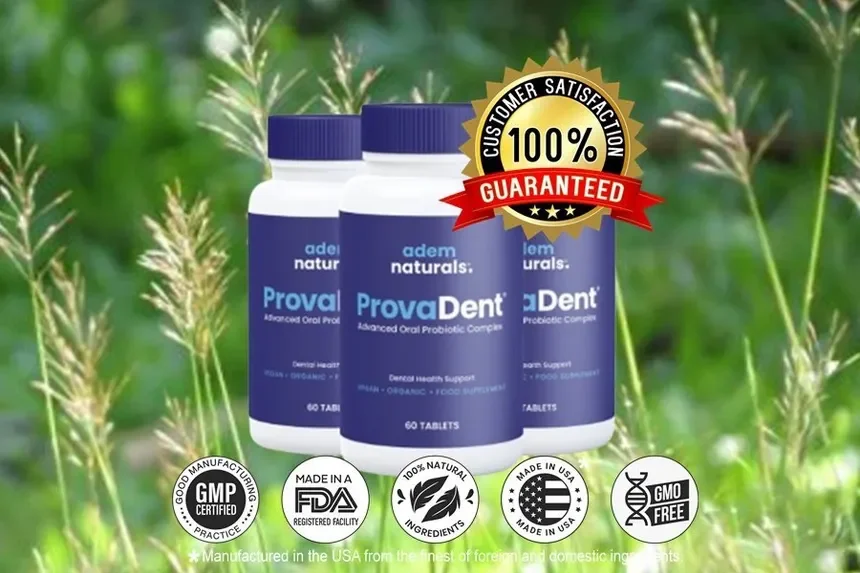
Oral probiotics have attracted growing scientific interest over the past decade as researchers better understand the role of the oral microbiome in gum health, breath quality, and systemic inflammation. ProvaDent by Adem Naturals positions itself at this intersection, combining probiotic strains with botanical co-factors in a chewable format designed for direct oral contact.
This review examines the ingredient profile, the available clinical evidence, and where ProvaDent sits in the landscape of evidence-based oral health adjuncts.
What Is ProvaDent?
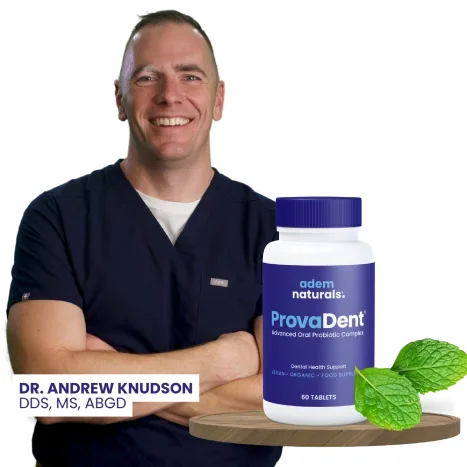
ProvaDent is an oral probiotic supplement in chewable tablet form, developed with claimed dentist participation by Adem Naturals. Each bottle contains 60 tablets. The formula targets gum health, breath freshness, and enamel support through a combination of probiotic strains and botanical compounds.
The chewable format is a rational design choice for an oral health product. Dissolution in the mouth maximises contact time between the active ingredients and the oral mucosa, which is the intended site of action.
The recommended use is one chewable tablet daily, allowed to dissolve fully in the mouth rather than chewed and swallowed quickly, since dissolution time is what drives the prolonged oral contact the probiotic strains and xylitol both depend on. A 60-tablet bottle provides a two-month supply at this dose.
Ingredients and Mechanism of Action
Lactobacillus reuteri
L. reuteri is the most consistently studied probiotic strain for oral health applications. It produces reuterin, an antimicrobial compound active against periodontal pathogens, and has been shown in randomised clinical trials to reduce bleeding on probing and probing depths when used as an adjunct to periodontal treatment. Vicario et al. (2013) demonstrated statistically significant improvements across all tested periodontal parameters after 30 days of L. reuteri administration in a double-blind placebo-controlled trial.
Lactobacillus salivarius
L. salivarius is a commensal oral strain with documented adherence to oral mucosal cells and salivary-coated hydroxyapatite, which is relevant to competitive exclusion of pathogenic bacteria. Shimauchi et al. (2008) conducted a randomised, double-blind, placebo-controlled trial over 8 weeks showing improvements in periodontal clinical parameters in subjects receiving L. salivarius WB21. Its inclusion alongside L. reuteri provides complementary mechanisms targeting different bacterial niches.
References:
- Vicario M, et al. (2013). Clinical changes in periodontal subjects with the probiotic Lactobacillus reuteri Prodentis: a preliminary randomized clinical trial. Acta Odontologica Scandinavica, 71(3-4), 813-819. DOI
- Shimauchi H, et al. (2008). Improvement of periodontal condition by probiotics with Lactobacillus salivarius WB21: a randomized, double-blind, placebo-controlled study. Journal of Clinical Periodontology, 35(10), 897-905. PubMed
🦷 ProvaDent combines L. reuteri and L. salivarius with cranberry extract and xylitol in a chewable format optimised for oral contact. A science-based option for adults managing gum sensitivity and breath concerns.
Learn More About ProvaDent →Cranberry Extract (Proanthocyanidins)
Cranberry proanthocyanidins (PAC) are among the best-characterised anti-adhesion compounds in oral microbiology. Koo et al. (2010) demonstrated that purified cranberry PAC fractions inhibit Streptococcus mutans biofilm formation on saliva-coated hydroxyapatite and reduce dental caries development in vivo. The mechanism involves inhibition of glucosyltransferase activity and bacterial glycolysis, disrupting the early stages of plaque biofilm assembly.
This is a meaningful ingredient, not a superficial botanical addition. The anti-adhesion mechanism is distinct from probiotic competitive exclusion and the two mechanisms are genuinely complementary.
Reference:
- Koo H, et al. (2010). Influence of cranberry proanthocyanidins on formation of biofilms by Streptococcus mutans on saliva-coated apatitic surface and on dental caries development in vivo. Caries Research, 44(2), 116-126. PubMed
Organic Xylitol
Xylitol is a non-fermentable sugar alcohol that is not metabolised by cariogenic bacteria, reducing the acid production associated with plaque acidogenicity. A systematic review and meta-analysis by Nasseripour et al. (2021) confirmed the Streptococcus mutans-reducing effect of xylitol, supporting its role as an adjunct in preventive oral care. Effects are most consistent when xylitol is delivered in forms with prolonged oral contact, which the chewable format supports.
Reference:
- Nasseripour M, et al. (2021). A systematic review and meta-analysis of the role of sugar-free chewing gum on Streptococcus mutans. BMC Oral Health, 21, 217. DOI
BioFresh Enzyme Complex, Vitamin C, Aloe Vera, Magnesium, Vitamin D, Purple Carrot Powder
The remaining ingredients address gingival tissue integrity and anti-inflammatory support. Vitamin C is required for collagen synthesis in periodontal ligament tissue. Vitamin D supports immune modulation relevant to the inflammatory component of periodontitis. Magnesium is a cofactor in over 600 enzymatic reactions and is commonly deficient. Purple carrot powder provides additional anthocyanins with documented antioxidant properties.
These are plausible supporting ingredients rather than primary therapeutic agents. Their inclusion is rational but their specific contribution to ProvaDent’s efficacy cannot be isolated from the probiotic and cranberry components.
What the Clinical Data Shows
An 8-week observational evaluation of ProvaDent reported the following outcomes:
- 17% reduction in plaque score
- 20% reduction in Gingival Index
- Reduction of 1.3 bleeding episodes per week during brushing
- Improvement of +0.9 points on a 1-5 breath freshness scale
These results are modest but internally consistent, and align with the direction of effects seen in independent trials of L. reuteri and L. salivarius. Effects are generally reported after 2 to 4 weeks of continuous use, with fuller results at 2 to 3 months.
The critical caveat is that this is an observational evaluation, not a randomised controlled trial with a placebo arm. Without a control group, it is not possible to distinguish the supplement’s contribution from natural variation, regression to the mean, or improved oral hygiene habits during the study period. This limitation is acknowledged and is the primary reason ProvaDent is assessed as an adjunct rather than a standalone treatment.
User Experiences

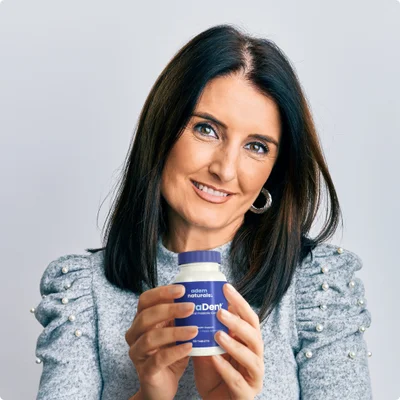
User-reported outcomes consistently highlight improvements in breath freshness and reduced gum sensitivity as the most noticeable effects, typically within the first 3 to 4 weeks. Results vary depending on baseline oral health status and compliance with standard oral hygiene practices.
Pros and Cons
✅ Pros
- Chewable format maximises oral contact time
- L. reuteri and L. salivarius have independent clinical trial support
- Cranberry PAC mechanism is well-characterised
- Xylitol adds complementary anti-cariogenic support
- 60-day money-back guarantee
- Good general tolerability profile
- GMP-certified, FDA-registered manufacturing
❌ Cons
- CFU count per tablet not disclosed
- Specific strain identifiers not published
- Observational data only, no independent RCT
- Premium price point ($49-69 per bottle)
- Available online only
- Results not immediate, requires consistent daily use
Who May Benefit
ProvaDent is most relevant for adults who:
- Experience mild to moderate gum sensitivity or bleeding during brushing
- Are concerned about chronic bad breath not resolved by standard hygiene
- Want to support oral microbiome health as part of a broader preventive approach
- Are already maintaining consistent brushing, flossing, and professional dental care
It is not a replacement for professional periodontal treatment in cases of established disease.
🦷 ProvaDent by Adem Naturals combines clinically studied probiotic strains with cranberry proanthocyanidins and xylitol in a chewable format designed for direct oral contact. A rational adjunct for adults prioritising oral microbiome health. 60-day refund guarantee.
Learn More About ProvaDent →Final Assessment
ProvaDent earns its rating through a thoughtfully constructed ingredient profile rather than through definitive independent clinical evidence. The probiotic strains, cranberry PAC, and xylitol each have meaningful scientific support in the oral health context. The observational outcomes are directionally consistent with that evidence.
The transparency limitations (undisclosed CFU count, unspecified strain identifiers) are genuine shortcomings that prevent a higher rating. For a product making oral microbiome claims, strain-level and dose-level specificity matters.
As an adjunct to consistent oral hygiene and regular dental care, ProvaDent is a reasonable choice for the target population.
Oral Health in Women: A Dimension Often Overlooked
Women face specific oral health challenges that are less well-recognized than their general health counterparts. Hormonal fluctuations across the menstrual cycle, pregnancy, and menopause have direct effects on gum tissue and oral microbiome composition that make women disproportionately susceptible to certain oral health problems at specific life stages.
During the menstrual cycle, progesterone rises in the luteal phase and creates conditions that favour the growth of certain periodontal bacteria. Many women notice increased gum sensitivity or bleeding in the week before menstruation, and this is not coincidental. It reflects a genuine hormonally-mediated change in gingival tissue response to existing plaque, not a change in oral hygiene.
During pregnancy, elevated estrogen and progesterone together amplify the inflammatory response to plaque to a degree that can accelerate the development of pregnancy gingivitis, affecting up to 70 percent of pregnant women to some degree. Periodontal disease during pregnancy has been associated with preterm birth and low birthweight in multiple studies, making oral health during this period a genuine obstetric concern.
Perimenopause and menopause bring declining estrogen levels that affect the oral mucosa directly. Reduced saliva flow, burning mouth sensation, altered taste, and increased bone resorption in the alveolar bone (which supports teeth) are all documented sequelae of estrogen decline. Post-menopausal women have higher rates of tooth loss and more rapid progression of periodontitis than premenopausal women.
An oral probiotic that supports a healthier oral microbiome composition provides a mechanism for reducing the pathogen burden that these hormonal shifts make it easier for the immune system to lose control of. It does not counteract the hormonal changes themselves, but it addresses one of their primary consequences at the microbial level.
Frequently Asked Questions
How long does it take to notice results? Most users report changes in breath freshness and gum comfort within 3 to 4 weeks of consistent daily use. Changes in gum bleeding on probing, the more clinically meaningful metric, are typically observed after 6 to 8 weeks in the clinical trial literature for oral probiotics.
Can I take ProvaDent alongside my regular oral hygiene routine? Yes, and this is the intended use. ProvaDent is designed as an adjunct to brushing, flossing, and professional dental care, not as a replacement. The clinical evidence for oral probiotics is consistently stronger when combined with standard hygiene than when used in isolation.
Does ProvaDent need to be refrigerated? The formulation is shelf-stable. Store in a cool, dry place away from direct sunlight.
Is ProvaDent safe during pregnancy? The probiotic strains in ProvaDent (L. reuteri, L. salivarius) have good general safety profiles, but as with any supplement during pregnancy, consult your healthcare provider before starting.
What if the product doesn’t work for me? ProvaDent comes with a 60-day money-back guarantee, which is sufficient time to complete a meaningful trial of the product and observe whether improvements in breath and gum comfort occur.
This post contains affiliate links. If you purchase through our links we may earn a commission at no additional cost to you. All content reflects an independent evidence-based assessment.
References:
- Vicario M, Santos A, Violant D, Nart J, Giner L. (2013). Clinical changes in periodontal subjects with the probiotic Lactobacillus reuteri Prodentis. Acta Odontol Scand, 71(3-4):813-819. DOI
- Shimauchi H, et al. (2008). Improvement of periodontal condition by probiotics with Lactobacillus salivarius WB21. J Clin Periodontol, 35(10):897-905. PubMed
- Koo H, et al. (2010). Influence of cranberry proanthocyanidins on formation of biofilms by Streptococcus mutans. Caries Res, 44(2):116-126. PubMed
- Nasseripour M, et al. (2021). A systematic review and meta-analysis of the role of sugar-free chewing gum on Streptococcus mutans. BMC Oral Health, 21:217. DOI
- Tonetti MS, Van Dyke TE. (2013). Periodontitis and atherosclerotic cardiovascular disease. J Periodontol, 84(4 Suppl):S24-29. PubMed
- Silk H. (2014). Diseases of the mouth. Primary Care: Clinics in Office Practice, 41(1), 75-90. Primary Care ENT