There is a version of this conversation that gets dismissed before it starts. Mention spirituality in a health context and some readers assume you are about to replace evidence with belief. That is not what is happening here.
What is happening here is a review of what the peer-reviewed literature actually shows about the relationship between spiritual practice, religious community, and measurable health outcomes. The data is more interesting than most people expect.
The Sermon on the Mount and the Science of Flourishing

The Greek word used in the Beatitudes is makarios, which is most accurately translated not as happy but as blessed, or deeply fulfilled, or flourishing. This is not a trivial distinction.
Jesus in the Sermon on the Mount was not describing circumstances that produce momentary pleasure. He was describing a quality of inner life that persists independently of external conditions. Blessed are the poor in spirit, the meek, the merciful, those who mourn, those who hunger for righteousness.
From a psychological standpoint, what the Beatitudes describe maps remarkably well onto what positive psychology has identified as the architecture of deep wellbeing: humility, which reduces the chronic stress of ego protection; mercy, which activates the caregiving neural systems associated with oxytocin and positive affect; mourning processed rather than suppressed, which research on grief confirms is necessary for psychological integration; and a orientation toward justice and meaning beyond the self, which is consistently associated with higher life satisfaction and lower rates of depression.
This convergence is not coincidental. It reflects something about human nature that both ancient wisdom and modern science are pointing toward from different directions.
Consider specifically “blessed are those who mourn, for they will be comforted.” Contemporary grief research has moved decisively away from the older model of grief as something to suppress quickly and “move past,” toward a model in which acknowledged, processed mourning is the psychologically healthier path. Studies on complicated grief, the kind that becomes chronic and impairing, consistently find that avoidance and suppression of grief responses are risk factors for its development, while open expression and social acknowledgment of loss predict better long-term adjustment. The Beatitude is not offering comfort instead of grief. It is naming mourning itself as the necessary path through which comfort becomes possible, which is precisely the sequence trauma and grief researchers have independently arrived at.
Consider also “blessed are the meek, for they will inherit the earth.” Meekness in the Greek text, praus, does not mean weakness; it describes strength held under control, the same word used to describe a trained horse that retains its full power while remaining responsive rather than reactive. This distinction matters clinically. Emotional reactivity, the inability to modulate response to provocation, is associated with elevated cortisol, cardiovascular strain, and damaged relationships. The capacity for controlled strength rather than either suppression or explosive reaction is closer to what modern psychology calls emotional regulation, one of the most consistently studied predictors of both mental health and relationship stability.

What the Research Shows
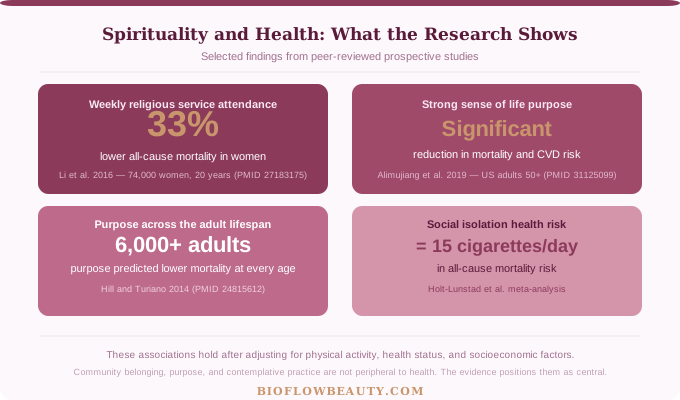
The epidemiological literature on religion and health is substantial. A landmark prospective study from Harvard T.H. Chan School of Public Health, following over 74,000 women for 20 years, found that those who attended religious services more than once per week had a 33 percent lower risk of all-cause mortality compared to those who never attended. The associations held after adjusting for lifestyle factors, socioeconomic status, and baseline health.
This is not an isolated finding. A meta-analysis published in JAMA Internal Medicine reviewing data from over 1,700 separate studies found consistent associations between religious involvement and lower rates of depression, anxiety, substance abuse, and cardiovascular disease, alongside higher rates of life satisfaction and subjective wellbeing.
The Blue Zones research, which studied populations with the highest concentrations of centenarians worldwide, identified faith community membership as one of the nine shared characteristics. Belonging to a faith-based community and attending services four times per month was associated with an estimated four to fourteen additional years of life expectancy.


The Mechanisms Behind the Association
Correlation between religious practice and health outcomes is well-established. The more interesting scientific question is why. Several mechanisms have been proposed and studied.
Social connection is probably the most significant. Religious communities provide a form of structured, repeated social contact that is associated with reduced inflammation, lower cortisol, and better immune function. Loneliness and social isolation are now recognized as risk factors for cardiovascular disease and premature mortality comparable to smoking fifteen cigarettes a day. Faith communities counteract this directly.

Stress regulation is another pathway. Prayer and contemplative spiritual practice activate the parasympathetic nervous system, reducing cortisol and heart rate in ways that neuroimaging studies have confirmed. The brain during focused prayer shows activity patterns similar to those observed during mindfulness meditation, with engagement of the prefrontal cortex and reduced amygdala reactivity.

A frequently cited study from the Université de Montréal used functional MRI to scan Carmelite nuns while they relived their most intense experience of religious union, comparing this state to a neutral control condition. The state of prayer was associated with measurable activation across the medial prefrontal cortex, anterior cingulate cortex, and insula, regions associated with emotional integration and self-referential processing, alongside reduced activity in the amygdala. The researchers were careful to note that this does not identify a single “God spot” in the brain, nor does it confirm or disconfirm any theological claim; it simply documents that the subjective experience of prayer corresponds to a specific, reproducible pattern of measurable neural activity, the same kind of evidence base used to study any other psychological state.
Purpose and meaning is perhaps the most powerful mechanism. A sense that one’s life has meaning and direction is one of the strongest predictors of longevity and psychological resilience across populations. Frankl documented this in extreme conditions. Modern positive psychology has repeatedly confirmed it in population studies. Faith traditions, almost by definition, provide a framework for meaning that secular frameworks often struggle to replicate.
Forgiveness deserves specific mention because it appears repeatedly in spiritual traditions and has its own emerging research base. Studies have found that the practice of forgiveness is associated with lower blood pressure, reduced anxiety, and better cardiovascular health. Holding chronic resentment maintains the body in a state of low-grade stress activation. Releasing it has measurable physiological consequences.
Gratitude is woven through nearly every major spiritual tradition, and it has accumulated one of the more robust physical health evidence bases of any single spiritual practice.

A 2023 systematic review pooling 19 randomized controlled trials and nearly 3,000 participants examined gratitude interventions specifically in people with cardiovascular disease, finding that structured gratitude practice was associated with improved adherence to healthy behaviors, reduced stress reactivity following acute cardiac events, and in some trials, measurable improvements in glycemic control markers including hemoglobin A1c. The proposed mechanism runs partly through the oxytocin system: expressing and receiving gratitude has been linked to genetic variation in oxytocin signaling associated with social bonding, which may help explain why a practice rooted in relationship and acknowledgment of gift produces measurable cardiovascular benefit rather than remaining purely psychological. For a tradition built around continual thanksgiving as a posture toward life, this is a meaningful confirmation that the practice is not merely a mood booster.
Service to others is woven throughout most faith traditions as a core practice rather than an optional add-on, and the research on volunteering specifically offers a useful lesson in scientific honesty. A systematic review and meta-analysis pooling cohort studies found that volunteers had a 22% lower mortality risk compared to non-volunteers. That finding sounds compelling, but the same review noted an important caveat worth taking seriously: while observational cohort studies consistently showed this mortality benefit along with improvements in depression and life satisfaction, the smaller number of randomized controlled trials available did not confirm the same physical health benefits. The honest interpretation is that people who already tend toward better health, stronger social integration, and greater resources are also more likely to volunteer, which means some, though probably not all, of the observed benefit reflects who chooses to serve rather than a direct causal effect of serving itself. This does not make the spiritual case for service any less valid. It does mean the physical health case should be held with appropriate humility rather than oversold.
🌙 Magnesium Glycinate The parasympathetic activation that prayer and contemplative practice support has a nutritional complement: magnesium is a cofactor in over 600 enzymatic reactions and is one of the most evidence-supported nutritional interventions for reducing the physiological stress response.
Check Magnesium Glycinate on Amazon →What Wisdom Literature Anticipated About Anxiety
The Beatitudes are not the only place in scripture where psychological insight precedes the formal language of psychology by millennia. The wisdom literature of the Hebrew Bible, particularly Proverbs and Ecclesiastes, contains observations about anxiety, worry, and contentment that read as remarkably consistent with what cognitive and behavioral research has since confirmed empirically.
Proverbs repeatedly connects an anxious heart to physical burden, observing that worry weighs a person down while a good word lifts them up, and that a cheerful heart is described in terms closely associated with physical wellness while a crushed spirit is associated with physical depletion. This is not poetic exaggeration. The biological pathway connecting chronic worry to measurable physical strain, sustained cortisol elevation, disrupted sleep architecture, and downstream cardiovascular and immune consequences, is precisely what modern stress physiology has spent the last several decades documenting in detail elsewhere on this site. The ancient text identified the pattern; the laboratory has since identified the mechanism.
Ecclesiastes adds something more specific: a sustained meditation on the limits of striving, achievement, and the accumulation of more, concluding that meaning is found in present contentment rather than in an endlessly receding horizon of more accomplishment. This maps with notable precision onto what hedonic adaptation research has documented: humans recalibrate quickly to improved circumstances, meaning that the pursuit of ever-greater achievement or acquisition produces diminishing psychological returns, while gratitude and presence in current circumstances are more reliably associated with sustained wellbeing. Ecclesiastes arrived at this conclusion through lived observation and reflection. Behavioral economics arrived at the same conclusion through controlled study. The convergence across nearly three thousand years is, at minimum, worth sitting with.
A Necessary Caveat: Correlation, Causation, and the Healthy Believer
Intellectual honesty requires addressing a question that the research summarized above raises but does not fully resolve: how much of this is religion itself, and how much is something else that happens to travel alongside it?
This is structurally similar to a problem nutrition researchers call healthy user bias. People who attend religious services regularly also tend, on average, to smoke less, drink less, marry and stay married more often, and have denser social networks independent of the religious content itself. Some portion of the longevity and mental health benefit attributed to religious attendance in observational studies likely reflects these correlated behaviors rather than spiritual practice in isolation. The 2016 Harvard study cited earlier attempted to statistically adjust for many of these factors and the association held, which strengthens the case considerably, but adjustment can never fully eliminate confounding in observational data the way a true randomized trial would.
There is also a selection question worth naming honestly: people experiencing acute health crises, severe untreated mental illness, or significant social instability may be less likely to maintain regular religious attendance in the first place, which means the comparison group implicitly excludes some of the people who might benefit most. None of this means the research is worthless or that the associations are illusory. It means the most defensible claim is a measured one: regular spiritual practice is robustly associated with better health outcomes across dozens of independent studies and populations, the proposed mechanisms are biologically plausible and in some cases directly measurable, and the honest causal picture likely involves both genuine direct effects and the correlated lifestyle and social factors that tend to accompany committed religious participation.
Practical Implications
This is not an argument that faith is a medical treatment or that spirituality can substitute for professional care. It is an observation that the research on human flourishing consistently points toward dimensions of life that purely materialist frameworks tend to undervalue.
For women specifically, faith communities have historically provided spaces of belonging, mutual support, and shared meaning that have protective effects on mental and physical health. The research on social support and health outcomes in women is particularly strong, and faith communities are among the most consistent sources of that support across cultures and across time.
This matters in a particular way during life transitions that disproportionately affect women: pregnancy and postpartum, caregiving for aging parents, and the hormonal transitions of perimenopause and menopause are all periods of elevated physiological stress where the buffering effect of community, contemplative practice, and a stable sense of purpose has the most room to make a measurable difference, precisely because baseline allostatic load is already higher during these windows.
What the research supports, regardless of one’s theological convictions:
Regular community belonging reduces isolation and its downstream health consequences. Contemplative practice, whether prayer, meditation, or reflective reading, regulates the stress response. Orienting toward purpose beyond the self is associated with better health outcomes at every age. Forgiveness practiced consistently has measurable physiological benefits. And the sense that one’s life has meaning, perhaps the deepest contribution of any serious spiritual tradition, may be the most health-protective of all.
References:
- Li S, et al. (2016). Association of religious service attendance with mortality among women. JAMA Internal Medicine, 176(6), 777-785. PubMed
- Koenig HG, et al. (2012). Handbook of Religion and Health, 2nd ed. Oxford University Press. Oxford Academic
- Toussaint LL, et al. (2015). Effects of lifetime stress exposure on mental and physical health in young adulthood. SSM Population Health, 1, 16-26. PubMed
- Beauregard M, Paquette V. (2006). Neural correlates of a mystical experience in Carmelite nuns. Neuroscience Letters, 405(3), 186-190. PubMed
- Wang Y, et al. (2023). The impact of gratitude interventions on patients with cardiovascular disease: a systematic review. Frontiers in Psychology, 14, 1243598. PubMed
- Jenkinson CE, et al. (2013). Is volunteering a public health intervention? A systematic review and meta-analysis of the health and survival of volunteers. BMC Public Health, 13, 773. PubMed
For more on the evidence-based foundations of women’s health and wellbeing, explore the related articles on BioFlowBeauty.